P: 470-574-0321
God So Loved the World
God So Loved the World
GCA 076 May 8, 2026 | 7:30 PM Season: 19 The Village at Indian Springs AmphitheaterDescription:
The beautiful gardens at Indian Springs provide the backdrop for our May concert, as we welcome the Minneapolis-based bluegrass group Monroe Crossing to collaborate with us. After an opening bluegrass set from our guests, the singers them for The World Beloved: A Bluegrass Mass, a work that was commissioned for Monroe Crossing, and has been performed numerous times all over the country. An end-of-season reception in the gardens caps off our 19th season, even as we look ahead to our 20thAnniversary Season.
- God So Loved the World (Stainer, John)
- Ballad: Refrain - The World Beloved: A Bluegrass Mass (Barnett, Carol)
- Kyrie - The World Beloved: A Bluegrass Mass (Barnett, Carol)
- Ballad: First Verse - The World Beloved: A Bluegrass Mass (Barnett, Carol)
- Gloria - The World Beloved: A Bluegrass Mass (Barnett, Carol)
- Ballad: Second Verse & Refrain - The World Beloved: A Bluegrass Mass (Barnett, Carol)
- Credo - The World Beloved: A Bluegrass Mass (Barnett, Carol)
- Sanctus - The World Beloved: A Bluegrass Mass (Barnett, Carol)
- Ballad: Third and Fourth Verses - The World Beloved: A Bluegrass Mass (Barnett, Carol)
- Agnus Dei - The World Beloved: A Bluegrass Mass (Barnett, Carol)
- Art Thou Weary (Instrumental) - The World Beloved: A Bluegrass Mass (Barnett, Carol)
- Benediction - The World Beloved: A Bluegrass Mass (Barnett, Carol)
- Conclusion - The World Beloved: A Bluegrass Mass (Barnett, Carol)
- Hark, I Hear the Harps Eternal (Parker, Alice)
How can a mostly improvisational musical genre that still proudly bears its rustic, untrained-musician credentials (though it has recently made inroads into demographics beyond its original audiences) blend with a sophisticated musical form heard almost exclusively in elegant concert halls and large churches?
That was the challenge the two creative artists commissioned by acclaimed Minneapolis choral ensemble VocalEssence faced: to compose a bluegrass mass. Poet Marisha Chamberlain and composer Carol Barnett were also joined in that commission by versatile Minneapolis-based bluegrass band Monroe Crossing, whom we are fortunate to have performing with us tonight–as they have joined choruses across the country in over thirty other performances to date of The World Beloved.
The beginnings of the project are recounted by Katryn Conlin, writing for the Soundingboard newsletter of the American Composers forum:
As Marisha worked on the libretto, Carol started learning about bluegrass. . . . She attended several Monroe Crossing concerts and delved deep into a collection of CDs supplied by [commissioning benefactor Mike] McCarthy—mostly Seldom Scene, Bill Monroe, and Earl Scruggs.
With Marisha’s completed libretto in hand, Carol set to work composing the music. Of course, she drafted the music in standard musical notation, which proved challenging for the bluegrass band as they began rehearsals. “We frequently play bluegrass at church services; in fact, that’s pretty much what we expected when we agreed to work with VocalEssence: a bunch of nice Gospel songs in the bluegrass tradition,” explained Monroe Crossing bass player Mark Anderson. “Instead, what we received was a true Mass in the traditional classical sense. There were constant time shifts between 2/2, 3/4, and 5/4 and the tempo and the key shifted frequently.” Mark said that fiddler/vocalist Lisa Fuglie was the only member of the band with the classical music background needed to read the music. “The rest of the band used the sheet music to facilitate learning the piece by ear.” [But] Lisa was confident that the combination of classical and bluegrass would work: “It’s just gorgeous. Some parts are more classical and some of it definitely has more of an Appalachian feel; it reminds me of Copland’s Appalachian Spring or Rodeo, where he adapted folk and fiddle tunes for orchestra. . . . Carol has listened to a lot of bluegrass music and it’s really influenced her. You can hear how some of her melodies are derived from bluegrass scales. In places you’ll find the crooked timing and extra beats just like you might find in bluegrass music.”
The World Beloved: A Bluegrass Mass was premiered in 2007 by Monroe Crossing and award winning choral group Vocal Essence under the direction of Philip Brunelle. Since then, Monroe Crossing has performed the piece over 90 times with choirs from California to Washington D.C. and many points in between. In 2013, under the direction of Kathy Menk, Monroe Crossing performed the piece in New York City at Carnegie Hall. They returned to Carnegie Hall the following year for a repeat performance, this time re-uniting with Philip Brunelle. In 2016, Monroe Crossing teamed up with Missoula based choir, Dolce Canto, and, under the direction of Peter Park, performed the piece at a variety of venues in South Korea!
Librettist Marisha Chamberlain is not only a poet but also a novelist and playwright. Georgia was among the states she lived in growing up, but she eventually settled in Minnesota, graduating from Macalester College in St. Paul. Prior to her collaboration with Carol Barnett on The World Beloved the two creative artists had combined forces on a 1997 chamber opera, Meeting at Seneca Falls, premiered by the Minnesota Orchestra.
Composer Carol Barnett has won numerous accolades, including commissions not only by VocalEssence but also by the Saint Paul Chamber Orchestra, the Harvard Glee Club, the Minnesota Music Teachers Association, and the Children’s Theatre of Minneapolis, along with grants from numerous prominent foundations. Others of her choral compositions are published by top-drawer houses such as Oxford University Press. She is a charter member of the American Composers Forum and a graduate of the University of Minnesota, where she studied composition with Dominick Argento and Paul Fetler. From 1991 to 2001 she served as composer-in-residence with the prestigious Dale Warland Singers.
In her preface to the choral score Barnett adds further background to the development of the work:
To bring the solemnity of the classical-based Mass together with the down-home sparkle of bluegrass—now there’s an assignment. My highest hope is that listeners coming from one tradition—classical or bluegrass—and perhaps dubious about the other, might discover something new and wonderful in the combination, as I have. Composing the music for The World Beloved has given me the chance to write cheery sacred music—all too rare in a medium rife with staid and even lugubrious settings. It’s brought me back to memories of music heard while visiting my grandparents: country music with a church flavor that told stories and came out of a scratchy old record player. Grandma would not have allowed dancing, but under the table I tapped my toes.
Most of us have some sense of what bluegrass music is all about, but the liturgical/musical form of the Mass may need explanation. The term “mass” derives from the root words meaning “meal” (as in the term “mess hall,” for example). The “Meal” involved is Holy Communion—in various interpretations a “recreation” of the Last Supper hosted by Jesus in the Gospel accounts of the week leading up to his death and resurrection. (The Last Supper also coincided with what was for Jesus himself the Jewish Seder meal commemorating the Israelites’ deliverance from slavery in Egypt.) For all Christians, the Communion is (as the name implies) a communal experience of the presence of Christ among them (though denominations differ in their understandings of the “form” Christ’s presence takes, and not all Christian denominations use the term Mass to describe the service). Because of the solemnity and importance of the Last Supper, from its earliest years the Mass took on a formalized, repetitive structure, containing many of the same components. With the addition of music starting with Gregorian chant in perhaps the 7th century and polyphonic (multi-part) singing in the early 14th century, the Mass began evolving to this day as an important form of musical structure alongside other long forms like the oratorio and choral symphony.
Perhaps as early as the 11th century the elements began to coalesce into what by the 16th century became identified as the Ordinary of the Mass—those elements which were to occur in every mass as well as in their particular order: the Kyrie, the Gloria, the Credo, the Sanctus (sometimes subdivided into Sanctus and Benedictus) and the Agnus Dei. Barnett follows this order, interspersing the traditional components with what she calls “Ballads” (sometimes further subdivided into “Verses”). But the remarkable interrelationships among all these components—from both Mass and bluegrass music traditions—are what truly that make up the genius of The World Beloved.
I.Ballad: Refrain
They say God loved the world so dear He set aside His crown
And cloaked Himself in human shape; they say that He came down,
And dwelt a while among us here.
He came on down.
The World Beloved begins and ends with nearly identical opening and closing solos—though with a surprise at the end, as we shall see. The opening soprano solo was sung in the premiere performance by Monroe Crossing fiddle player Lisa Fuglie, who reprises that performance tonight.
The opening Ballad sounds simple and folksy, but that impression is disarmingly understated. In many finely-crafted musical compositions, including gigantic masterpieces such as Brahms’s German Requiem and Beethoven’s Fifth Symphony, the opening notes represent a kind of “genetic code” whose implications unfold into nearly every other note and musical structure to follow. In the case of Barnett’s opening vocal solo, the two opening notes—and the words sung over those notes—tell us almost everything we need to know about the most important meanings in the work. These notes are the D above middle C rising to the B above, an interval of a sixth, one of the more “dramatic” intervals, especially when ascending. In music, the sixth is a pivotal interval in that if that tone is “flatted” it is called a minor sixth, lending a “darker” minor-key sound to the music. But Barnett’s interval is the major sixth, whose “brightness” implies a more “optimistic” outlook. In bluegrass music in particular, the notes D and B are banjo-tuning pitches, thus hinting at the unmistakable bluegrass-band sound soon to follow. (The major sixth is also important to musical ear-training, often remembered as the two opening notes of “My Bonnie Lies Over the Ocean”–also a folk tune.) The interval of the sixth re-appears very soon in the Kyrie movement in the rhythmic bass chords (also using other wide, open intervals like fifths and sevenths), quickly illustrating how important the opening two-note motif of the rising sixth will be throughout the entire Mass to follow.
But this opening motif of the rising sixth is also important to the text sung over those notes: “They say.” These two innocent-seeming words will put the entire rest of the text into important perspective. The rhythm of this two-note motif is also important. The second note is a dotted quarter note, held a long time relative to the first note and to the notes that follow. This “dwelling a while” on the dotted-half note emphasizes the word “say.” Although the words of the opening Ballad echo the famous Biblical passage John 3:16 (“For God so loved the world that He sent His only-begotten Son . . .”) the wording is still not identical with that famous Gospel passage. The “They say” establishes distance from the biblical text: not attempting to paraphrase John 3:16 but instead saying, in effect, “This is what is said about John 3:16” or “This is what people say about John 3:16.” Who might these people be? Original bluegrass musicians might know these “They” as their landowners, bank loan officers, mine owners, or other “city folk” who make up “The Establishment” in faceless authority over them. The “They” might also be nothing more than the offhand, vague conversational reference it seems. Yet perhaps the most important possibility for identifying the “They” is to see it as a statement about our ignorance. “They” sounds like it means an identifiable somebody, but it may in fact mean nobody. Chamberlain and Barnett use the wideness of the “gap” of the major sixth interval as a theme reminding us about the indirectness and limitation of human knowledge about the Divine.
II. Kyrie
Mercy! Oh, Kyrie! Have mercy!
Oh, Christe! Mercy!
Eleison. Kyrie eleison. Christe eleison.
Kyrie eleison, have mercy on creation!
Christe eleison, have mercy on our souls.
Many classical-music Kyries sound even serene and beautiful. Not so this confession Barnett indicates should be sung as “intense.” The pleas for mercy—blending both ancient Greek and modern English words—are even anguished in their vocal difficulty, often employing dissonant chords and extreme vocal-range-stretching.
III. Ballad: First Verse
A child walked forth on Eden’s way, a child stretched out her hand.
Oh, may I taste the apple there and take to understand the fruit of knowledge in my mouth,
And know of God firsthand.
Lisa Fuglie also sings this solo, touching in its gentle, buckboard-trot musical simplicity. This indirect representation of the biblical Eve is as an innocent child, not the “downfall-of-mankind” villainess she becomes in other less-loving interpretations. This is but the first of many “wide intervals” in the mass between a stereotype and a fresh view of a more down-to-earth human reality.
IV. Gloria
Glory be to God on high, who launched the sunlight, loosed the rain,
Who scattered stars across the sky, who piled the mountains, rolled the plains,
Who spilled the rivers and the seas. Oh, glory be.
Glory be to God below, for feather, fur, for scale and fin,
For vine uptwisting, blossom’s fire, for muscle, sinew, nerve and skin
And ev’ry feature set aglow. Oh, glory be to God below.
Oh, glory be for peace on earth, and prayerful be the human heart
That has required a Savior’s birth to make of earth heav’n’s counterpart,
So strife might stop and warring cease. Oh, glory be for peace.
Oh, glory be the gen’rous Hand who left us to our work and care,
Who gave us only few commands, but that we help each other bear,
Ah, bear life’s burdens. Pain and suff’ring ease. Oh, glory be,
Oh, glory, Gloria.
This foot-stompin’ hoedown bursts at its seams with the energy of the Creation it praises. The “distance” of the opening motif of the sixth manifests itself here in the wonderful poetry of the text, in which creatures are represented by the poetic device of synecdoche–a part of a whole indirectly representing the whole itself: “feather” for bird, “scale and fin” for fish, etc. As soprano, altos, and tenors sing the “Glory be for peace on earth” verse, the basses add an underlying counterpoint of the familiar doxology “Praise God from whom all blessings flow“ (Old Hundredth), and the band later picks up that tune again at the end of the verse.
V. Ballad: Second Verse & Refrain
Adam, he labored, Eve, she toiled, and many children bore,
And sometimes all was fruitfulness, and sometimes seasons wore
Them down to dust and emptiness and hunger at the door.
But they say God loved the world so dear He set aside His crown
And cloaked Himself in human shape; they say that He came down,
And dwelt a while among us here.
He came on down.
This verse is scored for Soprano and Alto soloists, beginning here again with fiddler Lisa, who is later joined by the soprano when the refrain motif returns, the two voices singing in close “country harmony” (including harmonies using the motivic sixth). The fact that the opening refrain returns at this duet of female voices indicates an important turn in the sung narrative, anticipating a significance revealed at the end of the Mass.
VI. Credo
Oh, I do believe a place awaits us far across the Jordan
And when we reach those mossy banks we’ll cast aside our oars.
Row on, row on, we’re crossing River Jordan,
Row on, row on, and no one goes alone.
Oh, I do believe a place awaits us high above the mountains
And when we reach that highest peak we’ll spread our wings and soar.
Climb on, climb on, we’re climbing Jacob’s ladder,
Climb on, climb on, and no one goes alone.
Oh, I do believe a resting place awaits us ‘cross the Jordan.
We’ll toss our coats, throw off our hats and take the seat of ease.
And it’s not the seat of riches and it’s not the seat of power.
Row on, row on, we’re crossing River Jordan.
Row on, row on, and no one goes alone.
Row on, row on, and no one goes alone.
The Credo is the Creed: the statement of belief (usually the Apostles’ or sometimes the Nicene Creed) used in more highly liturgical Christian churches. Rather than the expected statements of belief about the Persons of the Trinity, Marisha Chamberlain’s text and Carol Barnett’s music sing of simple human hope and trust. The reassurance that “no one goes alone” is both highly moving and perhaps surprising. The traditional hope is that Christ goes with us at death. Yet the ambiguity of the phrasing in the context of the communal nature of the Mass suggests that we can help accompany each other on all life’s journeys, perhaps even the final one.
VII. Sanctus
Sanctus, sanctus, sanctus, . . .
Dominus Deus Sabaoth.
Pleni sunt coeli et terra Gloria tua.
Hosanna in excelsis. Hosanna.
(Holy, holy, holy, Lord God Almighty. Heaven and earth are full of your glory. Hosanna in the highest.)
Perhaps because the Credo is an emotional act impossible to follow, rather than inserting a “Ballad” Barnett alters the pattern, by turning solely to the ancient power of the Latin, repeated over and over again, in praise of the otherwise unspeakable holiness of God. This verbal repetition is intensified by energetic, syncopated rhythms and choral textures that alternate between loud and softer dynamics and between two-part and as many as seven-part writing, all of this variety perhaps reflecting human uncertainty at how best to praise Dominus Deus Sabaoth. All the more remarkable, then, that the tone of the music is so cheerful.
VIII. Ballad: Third and Fourth Verses
The skies exploded, towers fell, the floods came rushing down and many souls were burned alive
Many souls were drowned and others set to marching, marching far from home.
Where are you now, our Savior dear, when we are all undone?
They say God loved the world so dear He set aside His crown
And cloaked Himself in human shape; they say that He came down,
And dwelt a while among us here.
He came on down.
Oh, Where are you now, our Savior dear?
Oh, I am here among you now though I must pass unseen,
And cannot say why this must be nor how I walk between your souls
And greater dangers than you have ever known,
To laugh with you and weep with you, my people, oh, my own.
It’s true, I love the world so dear I cast aside My crown
And cloak Myself in mystery so I can come on down
And dwell in and among you now. I come on down. Ah . . . [segueing immediately to the Agnus Dei]
The chorus begins by singing a version of an element often included in other musical forms of the Mass, particularly the Requiem Mass: the Dies Irae (Day of Wrath and Judgment). Relief enters in the form of a Tenor solo, at first suggesting the voice of Jesus. But so deep is the “mystery” of the Incarnation that the voice initially appearing to be Jesus almost immediately takes other “shapes”: first a solo Soprano but eventually the full chorus (both male and female voices).
IX. Agnus Dei
Agnus Dei, qui tollis peccata mundi, miserere nobis.
Agnus Dei, qui tollis peccata mundi, dona nobis pacem.
(Lamb of God, who takes away the sins of the world, have mercy on us.
Lamb of God, who takes away the sins of the world, give us peace.)
The Agnus Dei is also sung only in Latin, this time by unaccompanied voices, often divided into seven parts and (as in the Kyrie movement early in the Mass) reaching to the extremes of the voice ranges.
X. Instrumental: “Art Thou Weary?”
The instruments now take their turn, playing a setting of the popular 19th-century hymn with the opening words “Art thou weary, art thou languid, art thou sore distressed? / ‘Come to me,’ saith One, ‘and, coming, be at rest.’” Rather than the familiar hymn tune, the band plays an original country waltz, a quiet entertainment providing brief respite from that weariness and sore distress. The absence of human voices in this movement again reflects a hesitancy at presuming to speak of things that humans can never fully understand—a sense that human words cannot provide the relief that God (and, perhaps, wordless music) can.
XI. Benediction
Blessing be upon your heads. Bless the living, bless the dead.
Blessing, blessing be upon you, my people.
Blessing that you may go lightly through this world of woe.
Blessing, blessing be upon you, my people.
Blessings, and may you embrace God in guise of human grace.
Blessings, blessings be upon you, my people, now and forever.
This is Barnett’s only slight departure from the structural dictates of the Ordinary of the Mass. Traditionally, the Benedictus is often combined into the Sanctus, but Barnett concludes the choral portion of her Mass with a freestanding Benediction. The words are those of Christ, but here again this “voice” is divided into many, both homophonically and in increasing complexity and variety of vocal counterpoint (semi-canon, antiphony, fugue), although the ending returns to greater simplicity and quietness of vocal texture. This complexity is all the more remarkably “disguised” by the overall impression of simplicity in the return of the gentle buckboard-trot rhythm.
XII. Conclusion
They say God loved the world so dear She set aside Her crown
And cloaked Herself in human shape; they say that She came down,
And dwelt a while among us here.
She came on down.
The change to the feminine pronouns should really not be all that much of a surprise, so careful has been Chamberlain’s and Barnett’s verbal and musical groundwork-laying for this new perspective. In one sense, this ending brings the Mass full circle (the circle itself being an ancient symbol for the God who has no beginning or ending, an image also used in the well-known Appalachian song “Will the Circle Be Unbroken.”) No one who has read the popular 2007 novel The Shack or seen the 1999 film Dogma can claim surprise at the imagining of a female Deity (as well as, in the novel, a female Holy Spirit). Even in our limited human “seeing through a glass darkly” (as Plato and St. Paul remind us) we can understand that an omnipotent God has the power to “cloak” in any desired “shape,” including—but perhaps not necessarily limited to—the indisputably male Jesus of the Christian Gospels. “Feminine” images for God also occur in Scripture as well as in the original Hebrew and Greek of those biblical texts, too abundantly to itemize here. But this focus on the “bodily” manifestation of God is also a reminder about the coming full circle of the Mass: the communion meal is the shared experience of all believers present—the Body of Christ—which can equally include even the “communion of the saints,” as visualized in the down-home 1984 film Places in the Heart. In the face of any possible concern over the “gender” of God we also have the reassurance of the mighty folk hymn in tonight’s concert, Hark, I Hear the Harps Eternal, with its suggestion that perhaps all that we mere mortals need understand about the “identity” of the Deity is that we can–and should–sing “Glory to the Great I AM.”
Finally, one more full-circle-coming is a new answer to the question of who the “They” are in the work-unifying opening motif. “They say” may now also mean Chamberlain and Barnett, and that what they have “said” in and through The World Beloved is loving and grace-filled indeed.
Notes and translations (except where otherwise attributed) by Bill Pasch © 2014, 2026
MONROE CROSSING
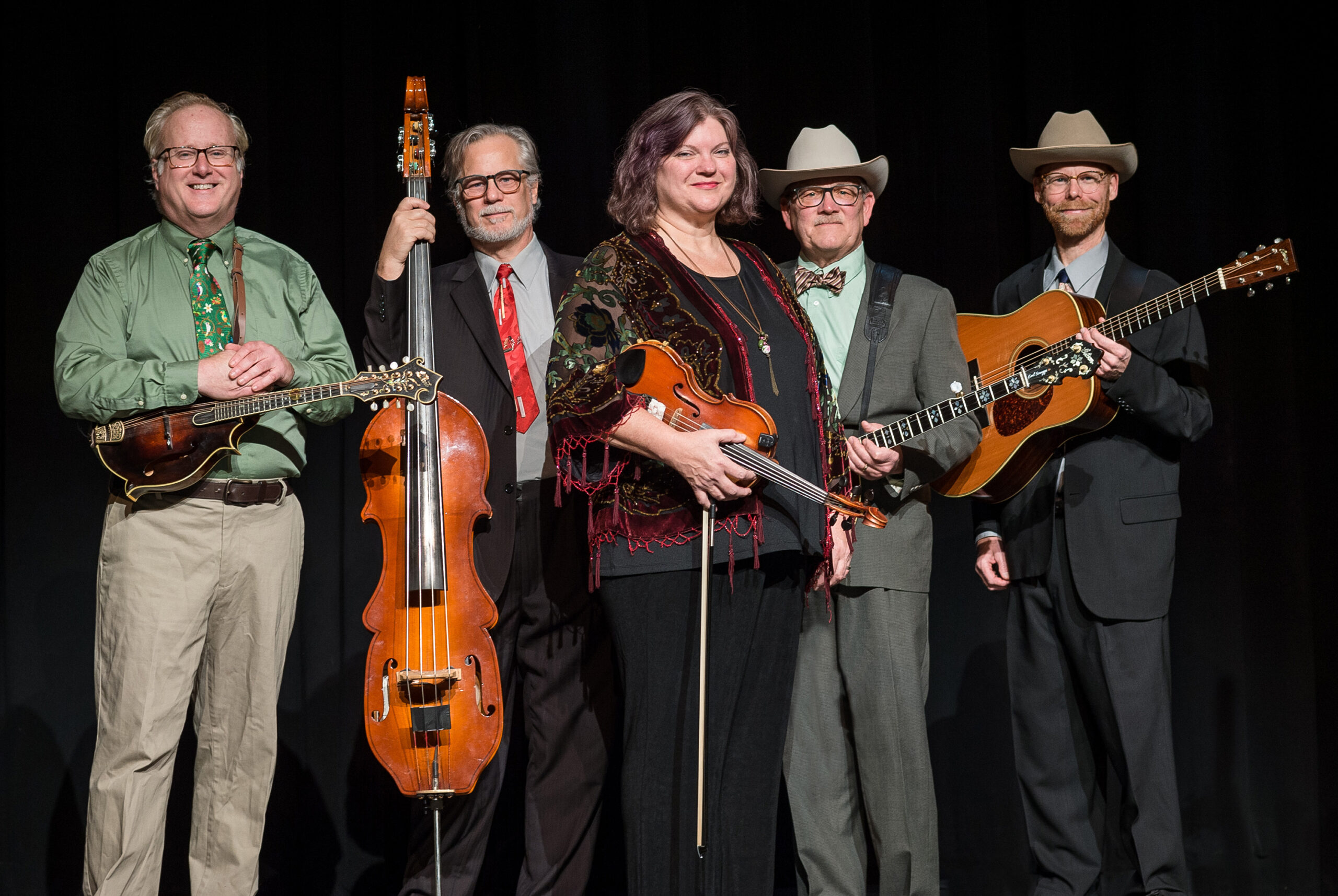
Monroe Crossing performs an electrifying blend of classic bluegrass, bluegrass gospel, original bluegrass and some surprising selections outside the bluegrass genre. Named in honor of Bill Monroe, the Father of Bluegrass Music, Monroe Crossing’s superb musicianship and on-stage rapport have entertained audiences throughout the United States, Canada and Europe.
For over 20 years this Minnesota based band has averaged over 100 shows a year performing in intimate rooms, community theaters, major venues and outdoor festivals. They are favorites among bluegrass connoisseurs and non-bluegrass audiences alike. They love introducing newcomers to bluegrass music!
Monroe Crossing consists of four distinct personalities with differing musical backgrounds. When combined, their individual histories make for a unique sound. The three original members are: Mark Anderson (bass), Lisa Fuglie (fiddle & lead vocals) and Matt Thompson (mandolin & harmony vocals). Derek Johnson (guitar & lead vocals) joined in 2011 and provides the booking duties for the band. Graham Sones is our talented banjo player.
In 2007, Monroe Crossing was inducted into the Minnesota Music Hall of Fame. They have twice been selected to showcase at the annual World of Bluegrass convention hosted by the International Bluegrass Music Association (IBMA). They have also appeared twice at Carnegie Hall in New York City. In 2016, Monroe Crossing had the honor of being the first Minnesota bluegrass band to perform in South Korea.
Monroe Crossing has released 17 albums to date. The band’s diverse discography consists of traditional bluegrass, original bluegrass, bluegrass gospel, a tribute to Bill Monroe, classic country, Christmas music and two collaborations with the award-winning choir Vocal Essence.
Whether playing bluegrass or material outside the genre, Monroe Crossing is one of the most entertaining acts in bluegrass today!